Showing posts with label Satellites. Show all posts

Sunday, February 1, 2009

ARRL: Bird's Eye Viewing

Go to the ARRLWeb's FCC License Data Search page and lookup the address of an Amateur Radio station you want to check out (type the station's call sign in the call sign field, then click on the "Submit Query" button).

When the search engine comes back with the results, copy the address to your computer's clipboard (select the address with your computer's mouse, then press the Ctrl-C keys).

Go to Microsoft's Live Search Maps page, paste the address in the Live Search field (press the Ctrl-V keys) then press the magnifying glass button.

More at http://www.arrl.org/news/features/2009/01/30/10601/

Friday, December 5, 2008

Getting started on amateur radio satellites

WHY SATELLITES? As a class-B licensee under the old rules, I did not have any HF privileges at all. Satellites offered a technical challenge and the possibility to work some serious DX using 2m and 70cm. My first trans-Atlantic contact was achieved on the now-defunct RS-10 using 10W to a small Yagi for the uplink, and a sloping dipole to receive the RS-10 downlink signal in the 10m band. It took several months to achieve this first trans-Atlantic QSO as I needed to build up my operating skills and make improvements to my receive set up. To minimise noise pickup from the house, the antenna went at the bottom of the garden and a homebrew RF pre-amp overcame the cable loss and boosted the signal. It was a great sense of achievement to send and receive signals to and from space and to make that contact via an orbiting satellite. I still get a buzz from communication via a spacecraft.

More at http://www.uk.amsat.org/images/PDF/Satellites_RadCom_mar07.pdf

Amateur Satellite Beginners Slides

Thursday, October 16, 2008

Downlink from Space with Richard Garriott Part 1

SSTV Video from the International Space Station

ARISS-SSTV images


This site will be the focal point for some of the best SSTV images received during Oct 2008 and beyond. Images will be downlinked by ISS on 145.800 MHz. To submit a received image for possible inclusion in this gallery, go to the following website to upload your image.

In addition to SSTV images, notes on planned events for the period of Oct 14-23 and reports of planned amateur radio activity will be provided.

More at http://www.ariss-sstv.blogspot.com/

SSTV Video From The International Space Station

SSTV Video From The International Space Station

Wednesday, October 15, 2008

W5YI: W5KWQ arrives at space station


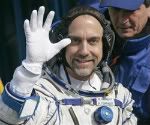
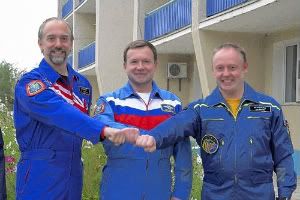
Oct. 14, 2008 - A Russian Soyuz spacecraft carrying three space travelers including Austin amateur radio operator/game developer Richard Garriott, W5KWQ, successfully docked with the international space station early today.

The linkup also delivered NASA astronaut Mike Fincke and Russian cosmonaut Yuri Lonchakov, who will take over as the Expedition 18 commander and flight engineer for the next six months. Fincke, 41, is making his second long-duration flight on the station. He is a graduate of Massachusetts Institute of Technology and holds master's degrees from Stanford University and the University of Houston, Clear Lake.

More at http://www.w5yi.org/ama_news_article.php?id=321

Tuesday, October 14, 2008

Getting started on amateur radio satellites

WHY SATELLITES? As a class-B licensee under the old rules, I did not have any HF privileges at all. Satellites offered a technical challenge and the possibility to work some serious DX using 2m and 70cm. My first trans-Atlantic contact was achieved on the now-defunct RS-10 using 10W to a small Yagi for the uplink, and a sloping dipole to receive the RS-10 downlink signal in the 10m band. It took several months to achieve this first trans-Atlantic QSO as I needed to build up my operating skills and make improvements to my receive set up. To minimise noise pickup from the house, the antenna went at the bottom of the garden and a homebrew RF pre-amp overcame the cable loss and boosted the signal. It was a great sense of achievement to send and receive signals to and from space and to make that contact via an orbiting satellite. I still get a buzz from communication via a spacecraft.

More at http://www.uk.amsat.org/images/PDF/Satellites_RadCom_mar07.pdf

Sunday, October 12, 2008

W5YI: U.S. ham operator launches to Space Station


Fulfilling a childhood dream, legendary video game developer and third generation ham operator Richard Garriott, W5KWQ, of Austin, Texas, blasted off into space aboard a Russian rocket early Sunday morning. He becomes the first American to follow his astronaut father, Owen Garriott, W5LFL, into space.

The Russian Soyuz TMA-13 spacecraft lifted off in perfect weather from the Baikonur Cosmodrome in Kazakhstan (a landlocked country in southern Europe) just after 2 a.m. Central time. Space officials said the Soyuz rocket reached orbit ten minutes later and will dock with the International Space Station (ISS) on Tuesday.

More at http://www.w5yi.org/ama_news_article.php?id=320

ARISS SSTV gallery


Check out SSTV images from ISS at http://www.amsat.com/ARISS_SSTV/

Tuesday, February 5, 2008

With AMSAT P5-A to MARS


Background information about Amateur Radio Satellites, their technique, construction, launch and operation. From satellites orbiting earth, to the latest plan for a first private satellite mission to MARS.
http://www.ticket-to-mars.org
http://www.amsat-dl.org